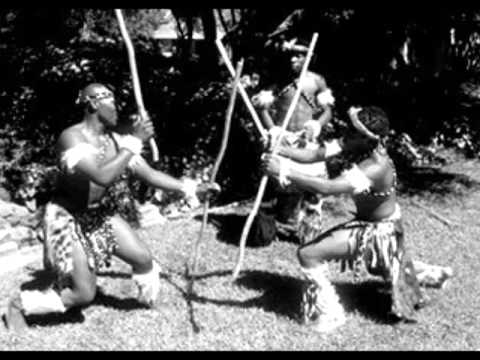
READ ALSO: Gena Ethiopian Traditional Game
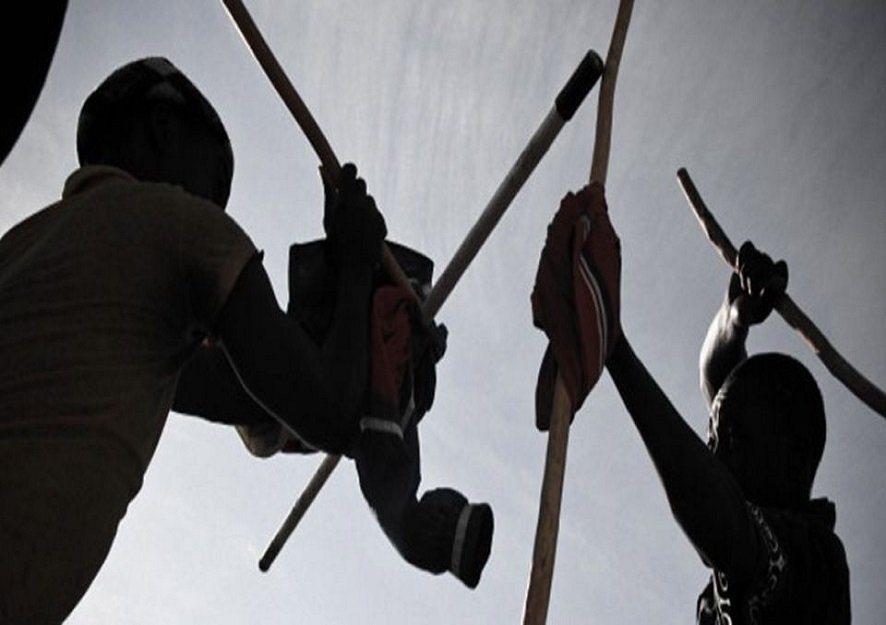
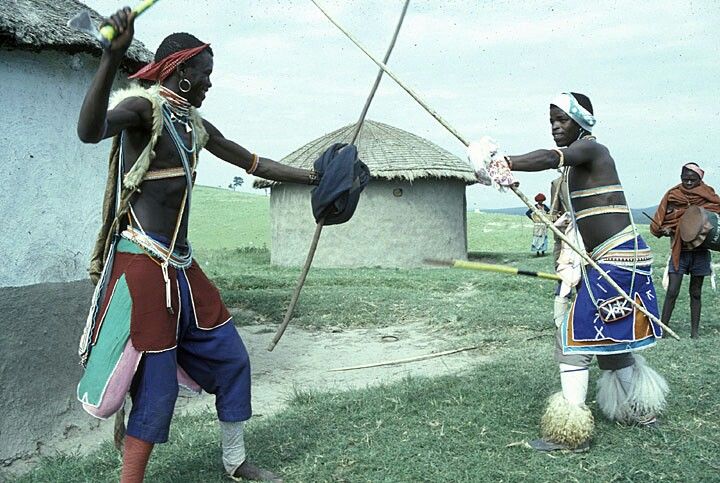
Zulu Stick Fighting & the Isikhwili Stick (Isikhwili Induku/Isikhwili Meaning)
Zulu stick-fighting uses an isikhwili, or attacking stick, an ubhoko, or defending stick, and an ihawu, or defending shield.
The object is for two opposing warriors to fight each other to establish which of them is the strongest or the “Bull” (Inkunzi).
In modern times this usually occurs as part of a wedding ceremony, where warriors from the bridegroom’s household and area welcome warriors from the bride’s household and area to meet to “get to know each other”.
Other groups of warriors may also be welcome to join in.
Warriors do this by engaging in combat with one another.
An induna, or war captain/referee, from each group of warriors keeps his crew in check and keeps order between fighters.
READ ALSO: site:chickabouttown.com
Table of Contents
site:chickabouttown.com/site:www.chickabouttown.com
If you would like to know what either of these terms mean, click here.
Traditional Sports in South Africa #1: Nguni Stick Fighting/Intonga Stick Fighting/South African Stick Fighting
Nguni stick-fighting is a martial art traditionally practiced by teenage Nguni herdboys in South Africa.
Each combatant is armed with two long sticks, one of which is used for defense and the other for offense. Little armor is used.
Although Nguni/Xhosa styles of fighting may use only two sticks, variations of Bantu/Nguni stick-fighting throughout Southern Africa incorporate shields as part of the stick-fighting weaponry.
READ ALSO: Fun Bub Cultural Game, 10 Traditional Games of Ethiopia & More
Isikhwili Nobhoko Photos
Traditional Sports in Africa/Traditional Games in South Africa #2: Dibeke (Traditional South African Sports)
Next on this list of traditional sports in Africa is Dibeke.
Dibeke (also called Nikkies, Skaloulo and Kimberley Jim) is a multi-running ball game played with two teams of 12 players.
The teams take turns to attack and defend. Individual attackers are called and must kick the ball beyond the centre lines towards the attackers’ box.
READ ALSO: South African Sports: Intonga & Isinaphakade Samathongo
South African Traditional Sports #3. Boers Folk Wrestling
The Boers, or Afrikaners, are South African people of Dutch, Flemish, German and French (Huguenot) descent.
Usually the Boers folk wrestling matches along with other rustic sports (the Boeresport) like climbing the slippery pole, foot racing, sack race, leaping, three-legged race, running with an egg in the spoon, tug of war, arm wrestling, archery, spit sheep manure, stick fighting and etc. were played on the annually held festival called the Farmers’ Day (the Boeredag).
A 1902 newspaper article had this to say about Boers wrestling: “Amongst the young Boers wrestling is exceedingly popular.
The champion wrestler of a district is as much thought of as is his confrere in the North of England. Such a man can always have the pick of the prettiest girls in the district for a wife.”
Wrestling customs of the Boers were of Dutch/Flemish origin.
The wrestling styles (worstelen, wrestling, or werpen/gooien, throwing) of Dutch and Flemish people existed in two distinctive modes: the standing wrestling for a throw and the up and down wrestling for taking someone down and overcoming him on the ground/keeping him underneath.
Among the wrestling techniques used by the Dutch/Flemish farmers were aanklampen (catching holds) and vasthaken (hooking legs). Plukharen (grasping hair) as well as any other non-wrestling or deliberately brutal acts were strictly prohibited during the wrestling contests.
Photo Credit: Face2Face Africa, Face2Face Africa