READ ALSO: Now, It’s Your Turn
Table of Contents
READ ALSO: Coffee Ceremony in Ethiopia PDF & More
Eritrean Traditional Coffee Ceremony/Eritrean Coffee Tradition/Traditional Eritrean Coffee Ceremony
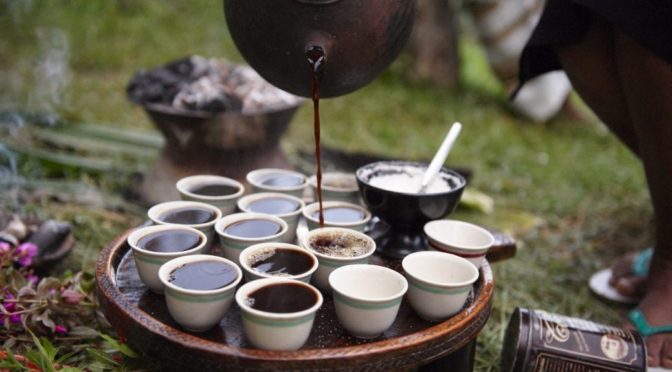
The Eritrean coffee ceremony is a traditional cultural practice that holds great significance in Eritrean society.
Similar to the Ethiopian coffee ceremony, it is a social event where coffee is prepared, brewed, and served to guests.
The ceremony is a symbol of hospitality, friendship, and community bonding.
Here are some key aspects of the Eritrean coffee ceremony:
- Preparation: The coffee ceremony is typically conducted by a designated host or hostess. The process begins with the washing and roasting of green coffee beans over a charcoal fire. The roasted beans are then ground using a mortar and pestle.
- Incense: During the ceremony, incense (typically made from frankincense or other aromatic resins) is burned to create a fragrant ambiance and ward off evil spirits. The pleasant aroma of the incense adds to the sensory experience of the ceremony.
- Traditional Coffee Pot: The coffee is brewed in a traditional clay coffee pot called a “jebena.” The jebena has a distinct shape with a narrow neck and a wide base. It is often adorned with colorful patterns or decorative elements.
- Brewing Process: The coffee is brewed using the jebena, typically placed on hot charcoal or an open flame. Water and the freshly ground coffee are added to the pot, and the mixture is brought to a boil. The brewing process is carefully monitored to achieve the desired strength and flavor.
- Three Rounds of Serving: Eritrean coffee ceremonies typically involve three rounds of coffee serving, each with a different name: “awel,” “kala’i,” and “bereka.” The first round, “awel,” is considered the weakest and is often served to children. The second round, “kala’i,” is stronger and is served to adults. The final round, “bereka,” is the strongest and is believed to bring blessings and good fortune.
- Serving with Snacks: Alongside the coffee, traditional snacks such as popcorn, peanuts, or roasted barley (known as “kolo”) are served to guests. These snacks provide a delightful accompaniment to the coffee and enhance the social aspect of the ceremony.
- Symbolism and Social Bonding: The Eritrean coffee ceremony is more than just a beverage preparation. It holds deep cultural and social significance, symbolizing friendship, hospitality, and community. It is a time for people to come together, share stories, and strengthen relationships.
The Eritrean coffee ceremony is not merely about the consumption of coffee but rather a celebration of Eritrean culture, traditions, and values.
It is an opportunity for people to connect, engage in conversation, and appreciate the importance of community and social bonds.
READ ALSO: Best Eritrean Food 2026 & More
Eritrean Kaffee
Im Deutschen wird „Eritrean Kaffee“ in der Regel einfach als „erit rea Kaffee“ verstanden, also Kaffee aus oder im Stil von Eritrea. Es ist kein traditioneller deutscher Begriff, sondern ein Ausdruck, der oft in der Vermarktung oder Beschreibung verwendet wird, wenn man auf die Kaffee‑Kultur Eritreas hinweisen will.
In Eritrea selbst spielt Kaffee eine sehr wichtige kulturelle und soziale Rolle. Eine der bekanntesten Traditionen dort ist die Kaffezeremonie, die bei Besuchen von Gästen, Familienzusammenkünften oder Festen abgehalten wird. Dabei werden die grünen Kaffeebohnen frisch über Holzkohle geröstet, anschließend zerstoßen und dann in einem speziellen Tongefäß namens Jebena langsam aufgebrüht. Der intensive Duft des Kaffees und oft auch von verbranntem Weihrauch erfüllt den Raum, während die zeremoniellen Schritte ausgeführt werden. Das gemeinsame Trinken von Kaffee gilt als Ausdruck von Gastfreundschaft, Gemeinschaft und Respekt. Bei der Zeremonie trinkt man meist mehrere Tassen in aufeinanderfolgenden Runden, die jeweils nach ihrer Stärke benannt sind.
Wenn also im Deutschen von „Eritrean Kaffee“ gesprochen wird, bezieht sich das darauf, dass es sich um Kaffee handelt, der mit der erit reaischen Kaffee‑Tradition verbunden ist – entweder durch Herkunft, Zubereitungsart oder kulturellen Kontext. Die Bezeichnung verbindet den Begriff Kaffee mit dieser besonderen sozialen Tradition Eritreas.
Photo Credits: aiic2015assembly.org
Hi Biche, I also love Ethiopian coffee. When I was in Ethiopia, it took the ladies more than 2 hours to prepare it (with the green grass and all that), but it was worth the wait. I also like the strong Swahili coffee in Mombasa, and even an Italian espresso.
Lol Rafiki,
Can we safely say you like strong coffee? Hehehe…
Thanks for sharing.
Biche
it is very delicious
Hi Muna,
Welcome to ChickAboutTown. Thank you for your feedback.
Biche
sounds wonderful, but here in this little town of Taos, New Mexico I don’t think thats a possiblity, but I will look for it in the stores. I’ve had to go to one cup a day due to heartburn, but I do enjoy that ONE and it’s fun trying different kinds. We (my honey and I) are currently exploring having traditional Turkisk coffee. we’ll see.
peace n abundance
CheyAnne
Hi CheyAnne,
Ethiopian coffee really is outstanding! How small a town is Taos? What’s the nearest big city to you? Maybe you might be able to get some authentic Ethiopian coffee there. There are Ethiopian restaurants in many of the bigger cities in the US.
Sorry about the heartburn. Out of curiosity, what is Turkisk coffee (or was that just a typo? Did you mean Turkish?)? Tell me more about that kind of coffee!
Biche
Taos is about 30,000 with a big county included north of Santa Fe, which is the capitol of New Mexico, but our biggest ‘city’ is Albuquerque which is roughly short of 3 hours away by vehicle, not to bad. We don’t care for it at all and love living as far off the grid as we can. ( written abit about that here…. http://newmexicomtngirl.com/2008/11/11/we-have-a-sotarano/ ) anyways,
Turkish is a sugar coffee grounds, brought to boil three times, very richness with foam and cardamon
peace n abundance
CheyAnne
ps almonds, raw or roasted stops heartburn in its tracks AND their good for you
Hi CheyAnne,
Your response has me smiling, remembering exactly why I love the Internet and blogging so much: I can connect with anyone, anywhere across the world, and learn so much about places I’ve never been to and about lifestyles so different from my own. First and foremost, thanks for sharing.
I’ll read your post (thanks for the link) and then inundate you with questions. You live off the grid? That’s cool! More on that after I’ve read your post.
Turkish coffee sounds great! I’ll have to try it out some time. I am not sure if there is a Turkish restaurant in Dar es Salaam, Tanzania, but I know there’s one that I frequent quite often when I am in Kampala, Uganda – a restaurant by the name of Effendy’s. I let you know what I think when I do. Same goes for you when you try it out, please! 🙂
Thanks for the heartburn tip. I have never thought of using almonds to cure heartburn and yet I often have almonds on hand at home. Thanks!
I wish you all the best!
Biche
What can I say? The two best things from Ethiopia are its coffee and women.
Hi Jonny,
Welcome to ChickAboutTown!
Even as a woman, I have to admit that you have a point! 🙂
Cheers,
Biche