Why is it easier to color a buzz cut?
If you’ve ever tried coloring long or thick hair, you probably already have an idea of the answer. Coloring can involve sectioning the hair, working the product through layers, making sure every strand is saturated, and then spending what seems like forever rinsing it all out. With a buzz cut, the process can be dramatically simpler.
Because buzz-cut hair is short and close to the scalp, you can usually apply color quickly and distribute it across the hair without having to deal with tangles, long ends, or multiple layers. You also need considerably less product, and rinsing can be much quicker.
But the simplicity of coloring a buzz cut doesn’t mean there are no things to consider.
Uneven application can be more noticeable on very short hair, and bleaching requires particular care because the hair is so close to the scalp.
So, what exactly makes a buzz cut so much easier to color, and what should you keep in mind before reaching for the dye?
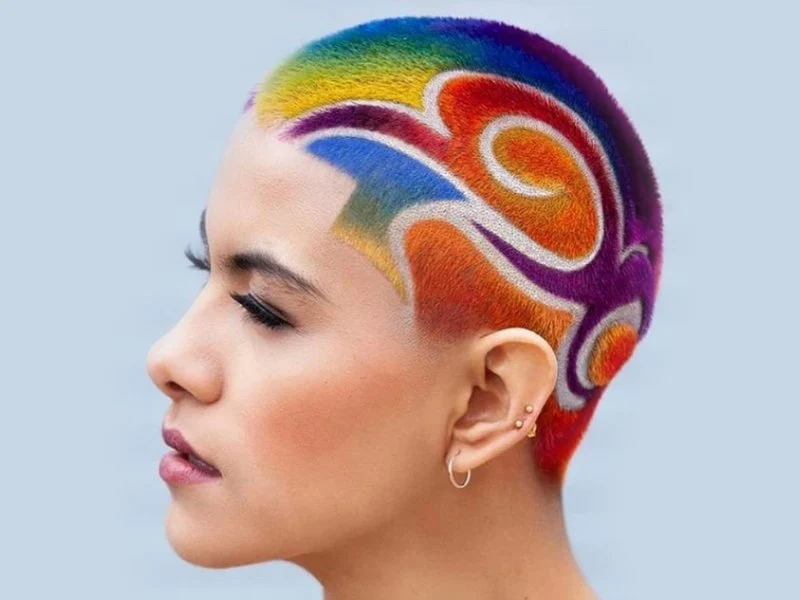
Table of Contents
Why Coloring a Buzz Cut Is Easier
Why Is It Easier To Color a Buzz Cut? Reason #1. You Can Reach Almost Every Strand Easily (Use a Brush To Dye Someones Buzzed Head)
With long or thick hair, dye has to be worked through layers of hair. You may need to section the hair, lift sections, and make sure the color reaches underneath.
With a buzz cut, the hair is so short that you can usually distribute the color directly over the entire head with your fingers or a brush. Very short hair often doesn’t require the elaborate sectioning used for longer hair.
Why Is It Easier To Color a Buzz Cut? Reason #2. There Is Much Less Hair To Saturate
A buzz cut requires considerably less product than long or very thick hair.
That makes the application quicker and makes it easier to get enough color onto the hair without having to work through a large amount of length.
3. There Are No Long Ends To Worry About
With longer hair, the ends can behave differently from the roots. Previously colored ends may be more porous and absorb color differently, while new growth can be more resistant.
That’s one reason conventional hair-color instructions often distinguish between roots, mid-lengths and ends.
A buzz cut essentially eliminates that problem because the hair is almost entirely close to the scalp.
4. You don’t have to fight tangles
Long hair can tangle while you’re applying color, making it harder to distribute the product evenly. A buzz cut has virtually no length to tangle.
5. Rinsing is incredibly simple
This is one of the biggest practical advantages. Instead of standing in the shower trying to get dye out of several feet of hair, you can rinse a buzz cut thoroughly in a fraction of the time.
6. You can use less product
This makes coloring a buzz cut relatively inexpensive, particularly if you are accustomed to buying multiple boxes of dye for long or thick hair. One box is generally enough for short-to-medium hair, while longer or very thick hair may require more.
But There Is an Interesting Catch
Easier to apply does not necessarily mean easier to get perfect.
Dyeing Buzz Cut Black
Dyeing a buzz cut black can be one of the easiest ways to make very short hair look dramatically darker, sharper and more defined. Because a buzz cut is so short, however, the result is a little different from dyeing longer hair.
You are coloring hair that sits very close to the scalp, so choosing the right type of dye and applying it carefully matters.
Why Black Works Particularly Well on a Buzz Cut
Black hair color can make a buzz cut look:
- Darker and more uniform
- Sharper around the hairline
- More defined in texture
- Glossier and healthier-looking, particularly when the natural hair has become dull
- More dramatic when paired with a fade, taper or very short sides
If your natural hair is already dark brown or black, you generally don’t need to lighten it first. In fact, going darker is considerably less damaging than lightening hair.
Dermatologists generally recommend staying close to your natural shade when coloring, and darker color typically requires less aggressive processing than going lighter.
Permanent, Semi-Permanent or Temporary Black?
This is one of the most important decisions.
Semi-permanent black is a good option if you’re experimenting with black hair or want something that gradually fades. It can also be preferable if you don’t want to commit to a permanent color.
Permanent black dye gives a more lasting result and is useful if your objective is consistent black coverage, particularly when you’re covering gray hair.
Temporary color can be useful if you simply want to see what black would look like before committing. It generally doesn’t have the staying power of permanent color.
There is another consideration with a buzz cut: your hair grows out quickly enough for the roots to become noticeable relatively soon. With very short hair, even a small amount of new growth can create a visible difference between your natural color and the dyed portion.
Be careful with the scalp
This is particularly important with a buzz cut.
Because the hair is so short, it’s easy to get dye on the scalp. Some staining isn’t necessarily dangerous, but hair dye can cause irritation or allergic reactions.
Ingredients such as PPD (paraphenylenediamine) are particularly associated with allergic reactions to hair dye.
Don’t dye a buzz cut if your scalp is already irritated, scratched, sunburned or otherwise damaged.
The FDA also recommends avoiding scratching or brushing the scalp for several days before coloring.
Always do the patch test
Even if you’ve used the same hair dye before without a problem, don’t assume you’ll always tolerate it. Sensitivity can develop after repeated exposure.
Follow the particular product’s instructions for its skin test. FDA guidance recommends testing a small amount on the skin and waiting 48 hours before coloring.
If you develop a rash, don’t use the product.
And don’t substitute a black henna product for hair dye.
Black henna can contain PPD and can increase the risk of becoming sensitized to PPD-containing hair dyes.
How To Color Buzz Cut Black
If you’re doing it yourself, the basic process is straightforward:
- Choose the black carefully.
If your natural hair is very dark brown, a natural black may look softer than an extremely blue-black shade. - Read the instructions completely before starting.
- Do the required patch test beforehand.
- Wear gloves.
- Apply the dye evenly to the short hair.
With a buzz cut, you don’t need to work through large sections. Make sure you cover the entire head rather than concentrating on the areas that look lighter. - Avoid deliberately rubbing large amounts of dye into your scalp.
The goal is to saturate the hair, not the skin. - Leave it on only for the specified amount of time.
Keeping dye on longer doesn’t necessarily produce a better black and can increase irritation. - Rinse extremely well.
Since the hair is so short, make sure the scalp is thoroughly rinsed too.
One Interesting Issue With Very Short Hair
If your buzz cut is extremely close, the color may not look as dramatic as you expect.
When hair is only a few millimeters long, you’re essentially seeing the color of the hair mixed visually with the color of the scalp underneath. A longer buzz cut will show the black more obviously.
For example, a #1 buzz cut may give you a very different visual result from a #3 or #4 buzz cut, even when exactly the same black dye is used.
And if you have gray hairs, those can sometimes stand out particularly strongly as the buzz cut grows.
What about dyeing gray hair black?
This can look striking on a buzz cut, but it’s also where maintenance becomes important.
If you have substantial gray and dye everything black, new gray growth can become noticeable relatively quickly because the contrast between black and gray is so strong.
One advantage of a buzz cut is that you don’t have to deal with long gray roots. You can simply recolor the short hair periodically. The disadvantage is that the regrowth can become visible across the entire scalp rather than just along a part or hairline.
If your goal is to make gray less noticeable rather than eliminate it completely, dark brown, charcoal or a softer black can sometimes give a less stark result than jet black.
A Word About the Hairline
Be particularly careful around your forehead, ears and neck.
Black dye can stain the skin and make a very short haircut temporarily look as though the hairline has been extended.
You can protect the surrounding skin according to the dye manufacturer’s directions, but don’t deliberately put hair dye onto your skin as a way of creating a darker hairline.
And never use ordinary hair dye on your eyebrows or eyelashes. Hair dyes aren’t intended for those areas and can cause serious eye injury.
The Bottom Line
Dyeing a buzz cut black is relatively simple, especially when you’re going darker rather than lighter. The main challenges are avoiding scalp irritation, getting an even application on very short hair, preventing unwanted staining and dealing with visible regrowth.
If your natural hair is already dark, I’d be inclined to consider a semi-permanent black first if you’re unsure about the look. If you’re specifically trying to get solid, long-lasting black coverage of gray hair, permanent color may make more sense, provided you tolerate the formulation.
Hair Dye Colors for a Buzz
A buzz cut gives you a particularly interesting canvas for hair color. Because the hair is so short, color becomes part of the overall shape of the haircut rather than simply something happening within the hairstyle.
Even a subtle tint can make a very short cut look completely different.
If your buzz cut is naturally black or very dark brown, you also have quite a few options that don’t require bleaching.
The important distinction is that dye can deposit color, but it generally can’t make naturally dark hair dramatically lighter.
On dark hair, some colors appear mainly as a reflection or tint, while others can be quite noticeable.
Black
Black is the most straightforward choice if you want the buzz cut to look clean, dense and intense.
You could choose:
- Natural black
- Jet black
- Blue-black
- Soft black
- Black-brown
Blue-black is especially interesting on a buzz cut because the hair can look black indoors but reveal a cool blue sheen in sunlight.
If you have gray hair, black will give you the strongest contrast with new gray growth, so it can require relatively frequent maintenance.
Deep Burgundy
Burgundy is one of my favorite colors for a dark buzz cut.
It gives you color without necessarily making the haircut look extremely unconventional. On naturally black or very dark brown hair, a highly pigmented burgundy can produce a reddish-wine reflection, particularly in sunlight.
Deep reds and burgundies are among the shades that tend to work particularly well on dark bases.
You could go toward:
- Burgundy
- Wine
- Merlot
- Deep cherry
- Oxblood
- Black cherry
A black-cherry buzz cut would be particularly subtle but gorgeous.
Deep Purple or Plum
A plum, eggplant or deep purple buzz cut can be striking without looking neon.
On black hair, you may see more of a purple glow than an obviously purple head of hair. That’s actually part of the appeal.
Dark purple pigments can show up as subtle tonal dimension on very dark hair.
I’d distinguish this from pastel purple. Pastel lavender generally requires a much lighter base to look like the color on the box.
Navy Blue
If you’re considering blue, I’d choose navy or midnight blue rather than an ordinary bright blue if your hair is naturally black.
A dark blue can give black hair a beautiful cool sheen without requiring the dramatic maintenance associated with bleaching. Blue-black and navy are among the more practical options for naturally dark hair.
A midnight-blue buzz cut could look almost black in some lighting and distinctly blue in others.
Emerald or forest green
This is more adventurous, but deep green can be surprisingly beautiful on black hair.
Think:
- Forest green
- Emerald
- Deep teal
- Green-black
Don’t expect an unbleached black buzz cut to become bright emerald green simply by putting green dye on it.
On a dark base, you’re more likely to get a green cast or reflective effect unless the hair is lightened first.
Some highly pigmented green formulas are specifically designed to produce visible effects on dark hair, however.
Red
Red is possible, but there is a big difference between deep red and bright red.
On very dark hair:
Deep red → potentially visible without bleaching
Burgundy → very good option
Cherry red → more visible if the base is lighter
Bright/fire-engine red → usually requires pre-lightening for a genuinely vivid result
So if you want red without bleaching, I’d look at wine, ruby, burgundy or black cherry rather than bright scarlet.
Copper and Auburn
If your natural hair is dark brown rather than true black, copper and auburn become more interesting.
A dark auburn buzz cut can give you a warm reddish-brown effect without looking as dramatic as fashion colors. On very dark hair, however, don’t expect a light copper result without lifting the hair first.
Chocolate or espresso brown
If you want something extremely subtle, you can actually use color to make a buzz cut look richer rather than obviously dyed.
Espresso, dark chocolate and deep brown can add warmth and dimension to dark hair.
This is particularly nice if your natural hair has started looking dull or if you want to soften the severity of an all-black buzz cut.
Silver, gray and platinum
These are probably the most dramatic choices.
A silver buzz cut can look fantastic, but naturally black hair generally has to be substantially lightened first. The same applies to platinum, white, pastel pink, lavender and many bright fashion shades.
This is where a buzz cut has an advantage: because the hair is short, you’re not committing to months or years of growing out heavily bleached lengths.
But bleaching the scalp area still requires care, particularly if you have sensitive or irritated skin.
Photo credits: Buzzcut Guide, Pinterest, Makeup.com, ArtFasad