If you have oily, breakout-prone skin, the idea of trying to moisturize acne might seem completely backwards. Why add more moisture when you’re already dealing with excess oil and pimples? But skipping moisturizer can actually leave your skin dry, irritated, and more uncomfortable, especially if you’re using acne treatments. The key is choosing the right moisturizer for your skin type — one that hydrates without feeling heavy or clogging your pores.
Table of Contents
Why Moisturize if You Have Acne?
It seems counterintuitive. If acne is associated with excess oil, why put moisturizer on your face?
Because oil and water are not the same thing.
Your skin can be oily while also being dehydrated or irritated.
Acne treatments such as benzoyl peroxide, salicylic acid, adapalene, tretinoin, and isotretinoin can also make the skin dry and irritated.
Moisturizer helps the skin tolerate these treatments.
When your skin becomes excessively dry and irritated, it can actually become more uncomfortable and potentially contribute to a cycle of irritation.
So aggressively trying to “dry out” acne isn’t necessarily helpful.
What Moisturizer for Whiteheads Is Best?
Look for these words on the label:
- Non-comedogenic
- Oil-free
- Won’t clog pores
- Acne-friendly
These formulations are less likely to contribute to clogged pores and breakouts.
If your skin is oily or acne-prone, a lightweight gel or gel-cream moisturizer can be particularly comfortable.
If your skin is dry from acne medication, you may need something richer.
Useful moisturizing ingredients include:
- Hyaluronic acid — helps attract water to the skin
- Glycerin — another effective humectant
- Ceramides — help support the skin barrier
- Dimethicone — helps reduce water loss and can soothe irritated skin
You don’t need an expensive moisturizer.
The formulation matters more than the price.
How To Use Moisturizer for Breakouts
A simple routine would be:
Morning
- Wash with a gentle cleanser.
- Apply a lightweight, non-comedogenic moisturizer.
- Apply broad-spectrum sunscreen, ideally SPF 30 or higher.
Night
- Gently cleanse your face.
- Apply your acne treatment if you’re using one.
- Apply moisturizer.
If your skin is particularly sensitive or you’re using a retinoid such as adapalene, moisturizer can be especially useful for reducing dryness and irritation.
One useful trick is to apply moisturizer while your skin is slightly damp after cleansing. This helps trap water in the skin.
What if Moisturizer Seems To Make Your Acne Worse?
Don’t assume that all moisturizers cause acne.
If a particular moisturizer consistently produces more bumps after you start using it, stop it and try a different non-comedogenic formulation.
Also look beyond your moisturizer.
Hair products, makeup, sunscreen and other skincare products can contribute to breakouts, particularly around the forehead and hairline.
And avoid the temptation to compensate for oily skin by using harsh cleansers, alcohol-based products or vigorous scrubbing.
Those can irritate acne-prone skin.
One Important Distinction
Moisturizer doesn’t treat the underlying acne by itself.
Think of it as supporting the skin and making an acne-treatment routine easier to tolerate.
For actual acne treatment, ingredients such as benzoyl peroxide, salicylic acid, and topical retinoids such as adapalene have much more direct roles.
So the basic idea is:
Treat the acne + moisturize the skin + protect it from the sun.
And if you’re dealing with dark marks after acne, moisturizing is still useful, but sunscreen becomes particularly important because UV exposure can make discoloration more persistent.
Best Moisturiser for Pimple Skin
If you have pimple-prone skin, the best moisturizer is usually one that hydrates without adding heaviness or clogging pores.
You do not need to stop moisturizing because your skin is oily or breaking out. In fact, keeping the skin barrier comfortable can make acne treatments easier to tolerate.
My Top Pick: Cerave PM Facial Moisturizing Lotion
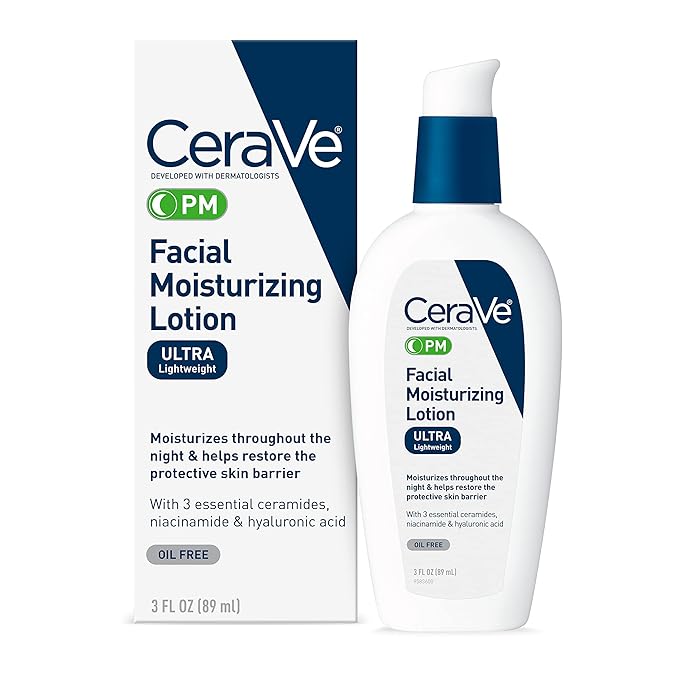
For an everyday moisturizer for pimple-prone skin, CeraVe PM Facial Moisturizing Lotion would be one of my first choices.
It is:
- Oil-free
- Non-comedogenic
- Fragrance-free
- Lightweight
- Contains ceramides to support the skin barrier
- Contains hyaluronic acid for hydration
- Contains niacinamide, which can be soothing for irritated skin
It is particularly nice at night, although you can use it during the day too.
Dermatology professionals commonly recommend it for acne-prone and combination skin.
Another excellent Moisturizer for Pimples: La Roche-Posay Toleriane Double Repair
If you want something a little more moisturizing, I’d consider La Roche-Posay Toleriane Double Repair Face Moisturizer.
It combines ingredients such as ceramides, glycerin, niacinamide and hyaluronic acid and is designed to moisturize while supporting the skin barrier.
It has also been repeatedly recommended for acne-prone skin.
If your pimples coexist with dryness, flaking or irritation from acne treatments, I might actually choose this over a very lightweight gel.
If Your Skin Is Very Oily
For very oily, shiny skin, a lighter or mattifying moisturizer may feel better.
La Roche-Posay Effaclar Mat is specifically formulated for oily skin and is oil-free and non-comedogenic.
Another option is La Roche-Posay Double Repair Matte, which combines a mattifying finish with ingredients such as niacinamide, glycerin, ceramides and hyaluronic acid.
If Your Skin Is Sensitive
I’d lean toward Vanicream Daily Facial Moisturizer. It contains ceramides and hyaluronic acid and is fragrance-free, making it a particularly reasonable choice if your skin gets irritated easily.
What I would look for on the bottle
For pimple-prone skin, prioritize:
“Non-comedogenic” + “oil-free” + lightweight + fragrance-free
Ingredients such as glycerin, hyaluronic acid, ceramides and niacinamide are useful because you can hydrate and support the skin barrier without necessarily making the product heavy.
I wouldn’t automatically avoid every moisturizer containing oils or every rich cream. Skin is individual, and the overall formulation matters. But if you consistently notice more clogged pores after using a particular product, it’s worth switching.
One thing I wouldn’t do
Don’t try to dry your pimples out by leaving your skin completely unmoisturized.
Acne treatments such as benzoyl peroxide, salicylic acid and adapalene can dry and irritate the skin. A suitable moisturizer helps counteract that irritation, and dermatologists specifically recommend acne-friendly moisturizers for this reason.
If I had to narrow it down to three:
- CeraVe PM Facial Moisturizing Lotion — best all-rounder
- La Roche-Posay Toleriane Double Repair — best if you need more hydration
- La Roche-Posay Effaclar Mat — best if you’re very oily and want a matte finish
And if by “pimple skin” you mean you currently have a lot of active pimples, rather than simply having acne-prone skin, the moisturizer is only one part of the equation. The choice of acne treatment underneath it becomes just as important.
READ ALSO: 3 Great Sun Block for Oily Skin & More